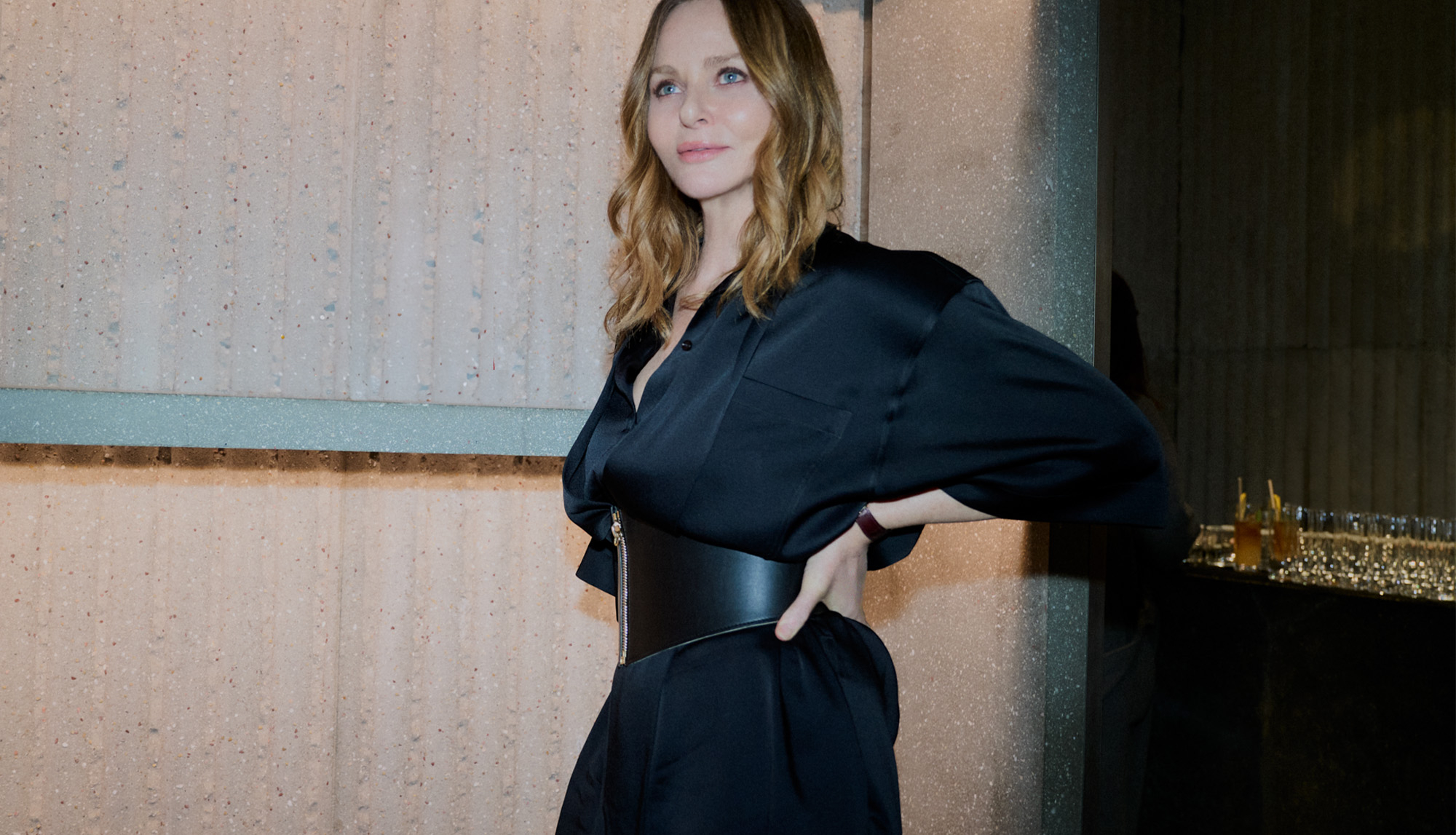
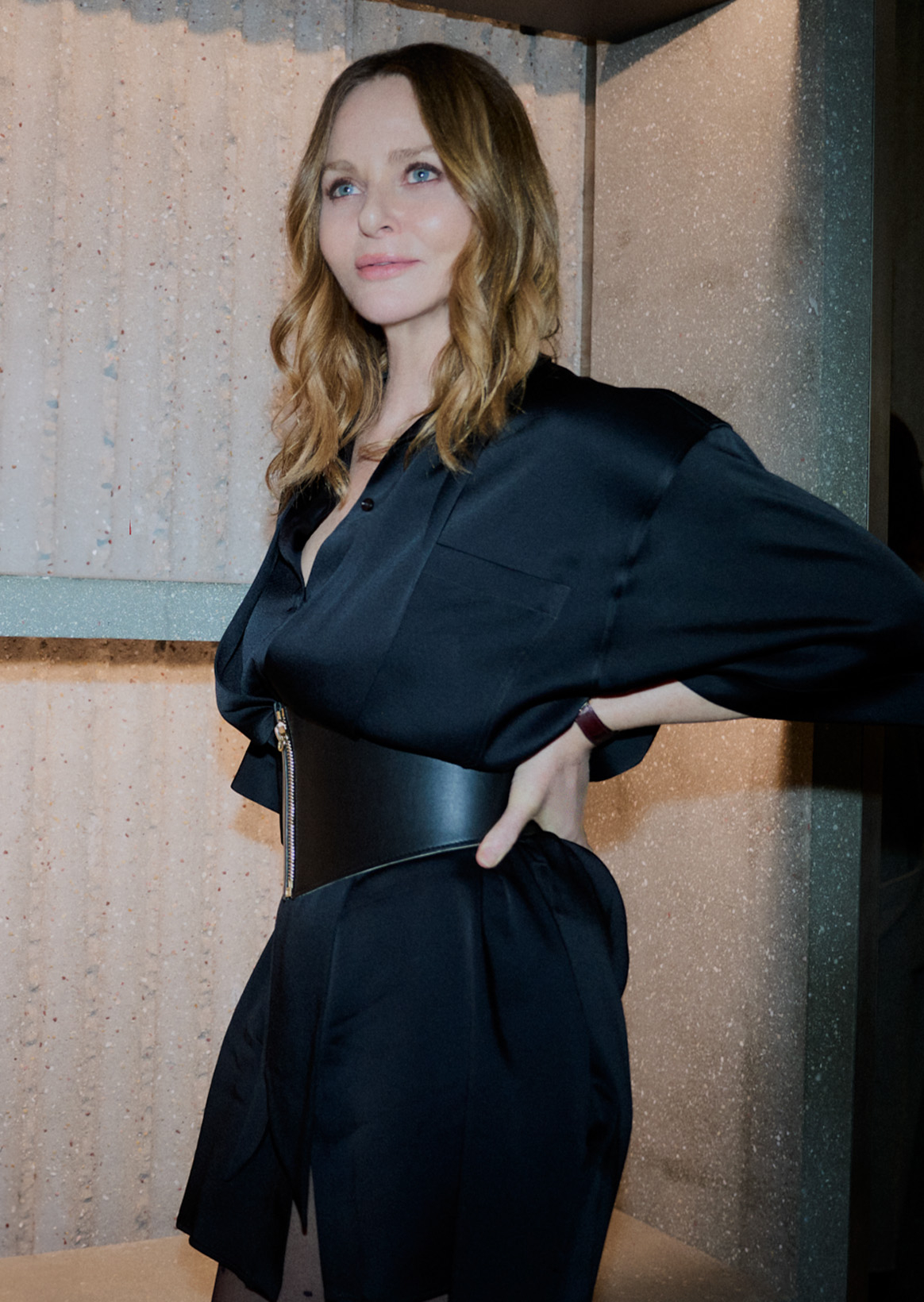
2001年Stella McCartney在英國倫敦成立了自己的豪華時裝店。自那時起,以可持續性與時尚並存作為品牌理念,於巴黎時裝週舉辦的2025年夏季跑道展中,展出了從作家兼野鳥觀察家Jonathan Franzen的著作《The End of the End of the Earth》獲得靈感,使用96%環保的材質,在不傷害生物的情況下所製作的系列。4月18日 (星期五),在澀谷PARCO的<Stella McCartney>新店鋪開幕。為了慶祝與<阿迪達斯>合作推出的RASANT日本限定顏色 (BLACK),我們向來到日本的她詢問了孕育獨一無二的創造力的環境,以及對自己品牌的想法。
※The English version is available below.
- Photo
- Sachiko Saito
- Text
- Tomoko Ogawa
- Edit
- RIDE Inc.
——從幼年時期開始,對自我形成最大的影響是什麼?
建立永續品牌的決定很簡單。因為那是我成長的環境,也是從小就被教導的。當我四五歲的時候,我最大的回憶就是我發現爸爸和媽媽共用衣櫃。有絕對的雄激素 (具有男女兩性的特徵) 。那是Wings活躍的葛蘭洛克時代。我以為是媽媽的衣服有一半,爸爸實際上也穿了。從那之後,我從母親的檔案中找到了一件花襯衫,我想「這件襯衫很帥!」,然後我看到了父親穿著它的照片。明明是好幾年前的事了,卻非常現代,那至今也是最先進的話題。從小就被衣服包圍,對我自己,以及現在的工作方式都有很大的影響。
——你有印象深刻的音樂嗎?
我總是回到我父母的音樂,特別是我和Wings一起巡演時的音樂。那是我的童年。在蘇格蘭的荒野中騎馬,或在前往下一場演出的途中搭乘旅遊巴士。那是我人生中非常令人興奮和情感豐富的時期。他們的音樂銘刻在我作為設計師和一個人的DNA裡。
—您能否談談培養您原創性和創造力的環境?
我認為時裝設計和建築之間有很多有趣的相似之處,但在中央聖馬丁藝術學院學習時,我意識到自己並沒有學到時裝設計的技術層面。學校更注重創意,而不是學習像裁剪訂製夾克這樣的技術,而這正是我真正想做的。所以我去了薩維爾街。我記得當時和一些堪稱時尚界「建築師」的人一起工作。他們是奠定基礎的人。製作一件夾克就像建造一棟大樓,我發現這一點非常有趣,所以我在那裡做了三年學徒,幾乎完全掌握了用蒸汽定型面料的技巧。那三年學到的技能一直是我的基礎,我認為剪裁現在是,將來也永遠是斯特拉·麥卡特尼品牌DNA中不可或缺的一部分。
——對你來說,改變遊戲規則的關鍵時刻或事件是什麼?
在中央聖馬丁斯的畢業表演非常重要。凱特摩斯、娜歐蜜坎貝爾和亞斯敏·勒本在那裡當模特兒,穿著我的衣服,我至今記憶猶新,這是一個令人難以置信的場景。
—Stella McCartney 是一個不斷平衡時尚與永續發展的品牌,它所珍視的核心價值是什麼?
我們的價值觀源自於優雅的Stella女性——她們大膽、強大,並且敢於傳遞嚴肅的訊息。我們希望女性感到自信和強大,因此我們的服裝設計兼具舒適性和實用性。同時,我們也致力於成為一家符合道德規範且與時俱進的公司,並且始終關注我們所使用的資源以及對環境的影響。我們非常自豪地看到,Stella McCartney品牌不斷創新,從設計到門市營運再到產品生產,不斷提升永續性。
——品牌和企業也反映了你自己的生活方式。
我一生都是素食主義者,我的系列不使用皮革、羽毛、毛皮或異國情調的皮膚。除此之外,我們還與新一代的創新者合作,創造對生物和地球母親友善的替代方案。SOS Fund是我的共同基金,致力於幫助這些具有永續發展願景的人,並且已經幫助他們將新材料推向市場,例如KelsunTM Seaweed Yarn (使用AI和酵素從塑膠廢棄物中回收的無限可回收聚酯纖維)和Protein Evolution。為了做到言出必行,Stella每天都在實踐。
—鑑於您在生產領域注重動物福利和環境保護,您認為這些服裝會對穿著它們的人以及社會產生怎樣的後續影響?
從一開始,關懷動物就一直是我個人選擇和Stella McCartney品牌願景背後的驅動力。 17年前,當我讀到聯合國《畜牧業的漫長陰影》報告,並將這一理念與畜牧業對環境的影響聯繫起來時,我才真正理解了這一切。
時尚產業是地球危害最大的產業之一。畜牧業約佔全球溫室氣體排放量的14.5%,超過了運輸業的13%。皮革生產也牽涉其中。皮革生產不僅會因開墾土地放牧牛群而導致熱帶雨林遭到破壞,還會向環境和當地水體排放約300公斤有毒化學物質。此外,皮革鞣製需要使用致癌化學物質,這往往會大幅縮短最貧困國家工廠工人的壽命。皮革生產在各個層面都極為殘忍。
每年有超過十億隻動物被飼養和屠宰,為時尚產業提供皮革。因此,我認為公眾、企業和政府最應該關注的是畜牧業及其對環境和產業的影響。企業應該摒棄那些傷害工人和動物的傳統有害材料和方法。我們還需要突破該行業傳統使用的有限材料,在替代材料方面發揮創造力和創新精神。如果我們共同努力實現這些目標,我們就能真正開始以一種能夠自我修復而非索取的方式開展業務。
——身為消費者的我們能做些什麼嗎?
透過要求品牌和政府的透明度和責任制,您也扮演著重要的角色。另一方面,政府必須創造激勵措施,讓企業以更永續的方式運作。例如,在美國,我的品牌在進口由純素材料製成而不是皮革的商品時,需繳納高達30%的稅。這是皮革產業遊說的直接結果,違背了我們對抗氣候變遷和保護地球以造福後代的共同目標。
——您目前有特別關注的材料開發或專案嗎?
全新的2025年夏季系列96%採用環保材料製成,我們很自豪能成為有史以來最具永續性的系列。Runway Show的靈感來自作家及鳥類觀察家Jonathan Franzen的著作『地球的盡頭 (End of the End of the Earth)』,是一個讚頌鳥類及呼籲行動的展覽。2025年夏季時裝系列不採用皮革、羽毛、毛皮或異國情調的皮革,而是採用創新的Kuruertyfree (※在產品到達消費者手中之前的任何階段,均未使用動物進行實驗。)材料製成,每年有超過34亿隻鳥受到傷害或殺害。
世界首款以Hydefy (真菌為基礎的紡織品) 製成的動物皮革替代品、KelsunTM服裝 (第一款以海藻為基礎的奢侈品) 和PEEKABOO再生尼龍紗線編織而成的雲狀針織品。鴿子珠寶與886 by The Royal Mint合作,以電子和醫療廢棄物回收的黃金和銀製成。支持新一代的創新者進入市場和擴大規模對我來說是非常重要的,這一季能夠接觸到這些優秀的紡織品是一個非常愉快的機會!
——在至今為止的活動中,您聽到了哪些令人難以忘懷的話語?
被稱為「環保怪人」!不使用動物性素材就能讓時尚品牌成功是不可能的。就算你一直這麼說我也完成了。我認為那是我們作為品牌至今為止做過的最現代的事。我們將不可能變成可能,證明我們可以在不傷害動物和地球的情況下,獲得美麗和理想的奢華。雖然有一點點的變化,但還是有必要讓更多的人和我們一起走下去。還有很多事情要做!
——在你的人生中,為了持續實現你心底想做的工作,你認為需要做什麼?
堅持自己的信念,用自己的方式做事,事業就不會成功,但不要改變工作方式。我們在Stella McCartney所做的事情,以及我們在創業時所做的事情,終於被認可並認真對待。那是我的榮幸。這種情況提供了一個很好的平台,鼓勵和討論在時尚界開展業務的其他方式,以挑戰現狀並對地球產生積極影響。
——請談談您對日本的印象和來日時的回憶。
我從以前開始就很喜歡日本的文化、時尚、音樂、藝術。這次來日本時,留在我心中的回憶之一,就是在東京時和好友奈良美智小姐的見面。他是非常棒的藝術家,我覺得我們有相同的願景和價值觀。
Stella McCartney established her eponymous luxury fashion house, Stella McCartney, in London in 2001. Since then, she has championed the coexistence of sustainability and fashion as the core philosophy of her label. At the Summer 2025 runway show during Paris Fashion Week―drawing inspiration from author and birdwatcher Jonathan Franzen’s book The End of the End of the Earth―she presented a collection made with 96% environmentally conscious materials, produced without harming any living creatures. On Friday, April 18, a new Stella McCartney store will open in Shibuya PARCO. Visiting Japan to commemorate the launch of a Japan-exclusive color (BLACK) of RASANT, a collaboration with Adidas, she spoke about the environment that shaped her distinctive creativity, as well as her thoughts on the brand.
——What has had the greatest influence on shaping who you are since childhood?
The decision to create a sustainable brand was easy; it’s what I grew up with and what I was taught from a young age. Some of my biggest memories from when I was four or five year old involve sitting in my parents’ wardrobe, and what was fascinating was I realised my mum and dad shared it. There was this absolute androgyny. It was this period of glam rock, during Wings. Half the things I assumed were mum’s, dad was actually wearing as well. They would swap. I’ve since worn a flowery shirt out of the archive and thought, ‘Oh look at this blouse of my mum’s, it’s so cool!’ Then we’d find a photo of my dad wearing it. It’s so modern; this was years ago, but today it’s a cutting-edge conversation to have. So, this upbringing and being around clothes from a very young age was a huge influence on me and has heavily inspired how I work today.
——Are there any films, music, or books (including photography books) that have left a lasting impression on you?
I always go back to my parents’ music – especially their time when they were touring with Wings. That was my childhood: going from riding on horseback in the wilds of Scotland to being on a tour bus on the way to the next gig. It was an incredibly exciting and emotional time in my life. Their music is in my DNA as a designer and a person.
——Could you share the environments, experiences, or things that have nurtured your originality and creativity?
I like to think that there are interesting similarities between fashion design and architecture in that when I was at Central Saint Martins, I realised that I wasn't learning the technical side of fashion design. The focus was on being creative rather than learning the technicalities, such as cutting patterns for a tailored jacket, for example, which is what I wanted to do, so I went into Savile Row. I remember working with those guys who I thought were like the builders of the fashion industry – you know, the nuts and bolts. Making a jacket is really like building a building, and it was just fascinating to me. I did that for three years, and I just about learned how to set a steam edit. I am constantly referring back to the skills I learnt in those three years, and tailoring is and always will be completely part of the Stella McCartney DNA.
——Can you tell us about a defining moment or event that was a game-changer for you?
I would say my graduation show from Central Saint Martins was pretty major. Having Kate, Naomi, and Yasmin there, wearing my pieces, will forever be something I am incredibly proud of.
——Your brand is well established as one that balances fashion and sustainability. What are the core values that Stella McCartney holds dear?
Our values are rooted in our Stella women – bold, badass, and unafraid to address serious messages, but always with a lightness of touch. I want them to feel confident and powerful, but with a signature effortlessness and ease. We are also committed to being an ethical and modern company, taking full responsibility for the resources we use and the impact we have on the environment. I am so proud of how we are constantly innovating new ways to become more sustainable, from designing to store practices and product manufacturing.
——Your brand and company reflect the very way you live your life, don't they?
I have been a vegetarian my whole life and have never used any leather, feathers, fur, or skins in any of my collections. Instead, I work with next-gen innovators to create alternatives that are kinder to our fellow creatures and Mother Earth. SOS Fund is an investment fund that I co-founded, which supports these sustainable visionaries and has already helped bring to market new materials like Kelsun™ -a bio-based material derived from seaweed, with a yarn-like texture and Protein Evolution – an infinitely recyclable polyester recycled from plastic waste using AI and enzymes. If you are going to talk the talk, you need to walk the walk, and we do that every day here at Stella.
——Prioritizing animal welfare and environmental conservation, how do you view the impact of your production process―not only on those who wear your designs but also on society as a whole?
Since day one, animals and their welfare have driven choices in my personal life as well as my vision for the house of Stella McCartney. When I connected this ethos with the impact that animal agriculture has on the environment after reading the UN’s Livestock’s Long Shadow report 17 years ago, it all clicked for me.
Fashion is one of the most harmful industries to the planet. Animal agriculture accounts for approximately 14.5% of the world’s greenhouse gas emissions, which is more than the transport industry at 13%. This is where leather comes from. Not only is leather driving the destruction of our rainforests by creating land for cattle, but it is also releasing almost 300kg of toxic chemicals into the environment, which are also entering local water systems. Leather also needs to be tanned with carcinogenic chemicals that drastically shorten the lives of factory workers, often in the most impoverished nations. It is cruel on every level.
Over one billion animals are raised and killed to supply leather to the fashion industry every year, so for me, the single most important thing for the public, businesses, and governments to focus on is animal agriculture and how it impacts our environment and industry.
Businesses need to transition away from these conventional, harmful materials and methods that hurt workers and animals. We need to get creative and innovative with alternatives, moving beyond the limited materials that the industry has been traditionally working with. If we work collaboratively with these goals, we can actually begin doing business in a way that regenerates our planet instead of only taking from it.
——Is there anything we, as consumers, can do to help?
The public too has an integral role to play by demanding transparency and accountability from brands and governments. Meanwhile, governments need to create incentives for businesses to work in a more sustainable way. For instance, in the US, my brand is taxed up to 30% for importing goods crafted from our vegan alternatives to leather. This is a direct result of the leather industry’s lobbying and is counter-productive to our shared goals of fighting the climate crisis and protecting our planet for future generations.
——Are there any specific material developments or projects you are currently focusing on?
My new Summer 2025 collection was crafted with 96% conscious materials – our most sustainable to date, which I am so proud of. The runway show was a celebration of birds as well as a call to action, inspired by author, birdwatcher, and Jonathan Franzen’s book The End of the End of the Earth. Over 3.4 billion birds are harmed or killed for down annually; the Summer 2025 collection avoids leather, feathers, fur, and exotic skins, opting instead for cruelty-free innovations, where neither the final products nor their ingredients were tested on animals at any point during development.
Alternative leathers included the world-first handbag made from fungi-based Hydefy, garments crafted from Kelsun™ ,-a seaweed-based textile available commercially for the first time in luxury, and-cloud-like knits spun from PEEKABOO recycled nylon yarn. I also designed wearable bird sculptures with 886 by The Royal Mint – each piece cast in metals repurposed from medical and electronics waste. Supporting the next generation of innovators in going to market and scaling is extremely important to me, so getting to work with these incredible textiles this season was really exciting.
——Among all your experiences, is there a statement that you will never forget?
It was being called an “Eco-Weirdo”! People said I could never have a successful business without using animal-based materials. I certainly have shown them, wouldn’t you say? I think it’s the most modern thing we have ever done as a brand – we challenged the norm and proved you can have beautiful, desirable luxury without harming animals or the planet. I can see the shift happening slowly, but I still need more people to come to my side of the world. There’s a lot of work to be done!
——When facing challenges in your career or life, how have you managed to overcome them?
I’ve stuck by my beliefs and haven’t changed the way I want to work, even when people would tell me I wouldn’t have a successful business if I did things my way. I feel like what we do at Stella McCartney, and what we’ve been doing from the start, is finally being recognised and taken seriously. I find that to be a great honor. It has given us this incredible platform to encourage and talk about other ways of doing business in fashion, to challenge the status quo and have a positive impact on the planet.
——What is your impression of Japan? Do you have any memorable experiences here?
I have always loved Japanese culture and the celebration of fashion, music, and art. One of my favourite recent memories was meeting up with my dear friend Yoshitomo Nara while I was in Tokyo. He is such an incredible artist, and we share such a similar vision and values.

史黛拉麥卡尼
Stella McCartney出生於倫敦的一個創作者家庭,他對公眾具有傳奇色彩,但在家庭中卻很普遍。她在城市和英國的鄉村地區長大,她的已故母親兼繆思琳達麥卡尼(攝影師、素食主義者、動物保育人士)讓她過著踏實的生活,她的價值觀和天生對美的欣賞信念一直啟發著她。
他於1995年畢業於中央聖馬丁斯學院 (Central St.Martins),不久之後便以其銳利的裁縫和大膽的美學而聞名。1997年,他擔任Chloe在巴黎的創意總監,領導Maison取得成功。
2001年,Stella McCartney成立了以她的名字命名的奢華時裝店,並於同年10月在巴黎發表了她的第一個時裝展。Stella是一位終身素食主義者,從品牌創立至今,一直堅持創新的態度,不使用皮革、羽毛和皮草。自成立以來,Stella透過材料和供應鏈的創新和合作夥伴關係,持續擴大其在可持續發展領域的領導地位。
Stella McCartney
Stella McCartney was born in London into a family of creators who were legendary in public, yet ordinary at home. Raised in both the city and the English countryside, she was kept grounded by her late mother and muse, Linda McCartney―a photographer, vegetarian, and animal rights activist whose values and innate appreciation for beauty continue to inspire her today. After graduating from Central Saint Martins in 1995, she quickly gained recognition for her sharp tailoring and bold aesthetic. In 1997, she was appointed Creative Director of Chloé in Paris, where she led the house a great success. In 2001, she launched her eponymous luxury fashion house and debuted her first collection in Paris that October. A lifelong vegetarian, Stella has never used leather, feathers, or fur in her designs. From the outset, she has maintained an uncompromisingly innovative approach, and since the brand’s inception, she has continued to expand her leadership in sustainability through material and supply chain innovations as well as impactful partnerships.

- 商店名稱
- STELLA McCARTNEY
- 樓層
- 2F
- 官方品牌網站
- https://www.stellamccartney.com/jp/ja/
- 官方SNS
- Instagram(@stellamccartney)